
Everyone Needs A Schtick
Court rather than kidnap

Everyone needs a good schtick, especially writers. Without one, you risk having that novel you labored so hard over becoming nothing more than a well-crafted diary. Stories are meant to be shared. That goes for all art, but the viewer needs to know why they should care. They need a sign that tells them they can trust you. That’s the efficacy of the schtick. It lights both cigarettes with one flame.
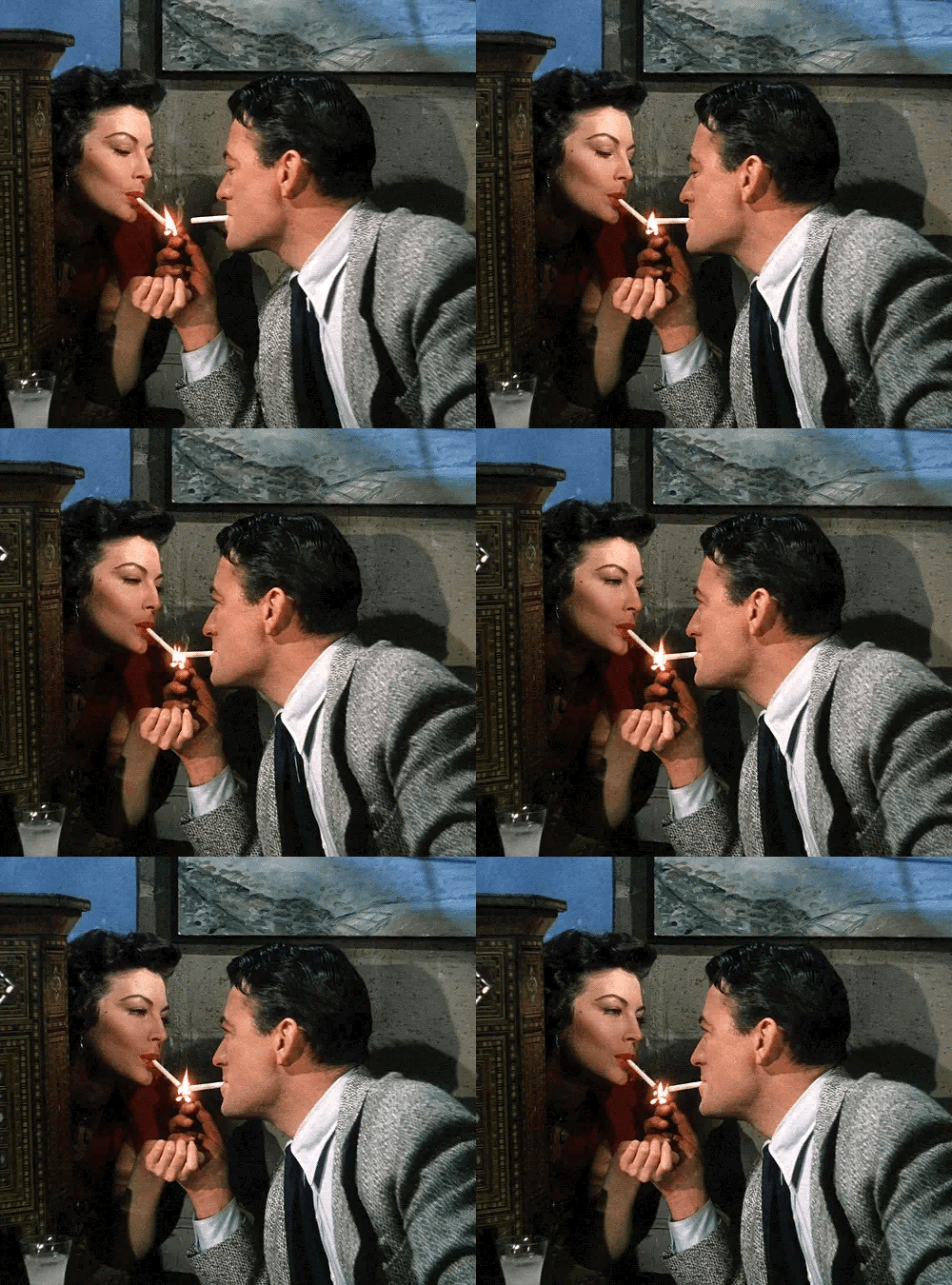
I learned this the hard way after my first open mic. In 2023, I signed up at my local coffee shop. The place was packed with about 50 people. There was a good buzz in the air. The shop was new, the open mic was a new event, and telling a story to a crowd was new, for me at least. It was my first time ever being on a stage.
The week before I stepped to the mic, I started to overthink the story I was going to tell. I was stuck between whether or not I should make a safe “business decision” or “really go for it” to see what I could pull off.
I had zero stage experience, zero public speaking experience, and zero experience on a microphone. The crowd was filled with people who knew me, but not this expression of me. It was obvious that all signs pointed to “make the safe business decision.”
So, what I did was choose to ignore the glaring conventional wisdom, and I swung for the fences instead…
Did I lose the room at one point? You bet your “A” double snakes I did.
Was it a total train wreck? Not totally. More like a fender bender at a 4-way.
I was fortunate that the punchline at the end landed well and got the intended laugh. But oof! The middle part where my overthinking convinced me to add extra—yikes. I really suvved the prey (as we say in our West Frankfort Gypsy tongue).
I’ve done more open mic’s since then. I’ll admit, I never feel good afterwards. There’s a drill sergeant in my head that just picks myself apart. I was the same way playing sports. My focus defaults to always trying to improve where I can, but—unlike in football—on stage I have no experience, no team, nor coach. It’s hard to pin down what edges need sanding.
Then one day I learned the value in the art of the schtick from watching stand-up comics. There were 5 openers at this arena show in St. Louis. Every comic did the same thing, they established trust with the crowd in the first 15 seconds. Even the comic who played the heel to the audience established trust in his own inverted way. He knows his dark shock humor is funnier if the audience stays at a certain moral distance from it. That way it’s obvious they aren’t laughing because they agree, but because it’s artfully ironic. He knows it is funnier for you if you don’t accept him. He’s trying to tell jokes, not spread a twisted manifesto, and his schtick worked like a charm. Everyone was appalled at the taboo but laughed more at his set than any other.
That’s when I realized the schtick establishes trust at the outset; in the introduction. You need a schtick or a spiel to set a tone because trust takes time, and time is limited on stage. That’s where the schtick and the spiel come in handy.
When you have that trust you have more license to explore various depths in a story, or a joke. The art of the schtick is part of the repertoire of a good storyteller, including the traditional ones.
A common misconception is that a schtick is inauthentic. That can be true, but definitely doesn’t have to be. It can be a compressed pattern, or a micro of the macro rather than a costume. I think the essence of a schtick is better reflected like ‘the tricks of the trade’ in the old John Wooden quote that says,
“If you’re too busy learning the tricks of the trade, you’ll never learn the trade.”
It’s not that schticks and spiels and tricks aren’t helpful. They definitely are. They just aren’t everything. That’s what my previous post covered. But if you can have both, then take both.
When I worked construction I found there are 3 types of carpenters. Their skill-levels are represented by their mantras:
“By the time they see this, I’ll be dead.”
“Good enough for who it’s for.”
“There’s a right way to do everything.”
If you master the schtick but not the trade, you’re carpenter #1: Low quality. Less jobs. Less money.
Carpenter #2 isn’t bad, but there’s better ones out there, and they get paid more per hour. Acceptable.
Carpenter #3, typically has a good pitch, manages customer conversation effectively, and in the end, delivers a high-end finished product.
#3 is always in high demand. Doesn’t disappoint.
It’s true in writing. We always say grab their attention in the introduction. “Say something interesting.” That’s because intrigue is also a form of trust. We never risk lending our attention to what we don’t believe contains promise.
It’s like a good pick-up line. It should contain a reflection of the authentic character, but it also needs to remain playful enough that the other person accepts the invitation willfully. Listeners and readers need courted not kidnapped. The schtick helps do that.
It’ll also benefit writers promoting their books. You didn’t work that hard just for it to be your own personal diary, right? I mean, you can’t go on a date with someone you never talk to. Treat your audience the same way.
Tell them your name, what you’re about, and why the world just might end if you don’t take them out to dinner ;) or, in this case, if they don’t read your book.
Art is meant to be seen. We write to be read. It’s not complicated. We all know what the deal is. It’s okay to want that. It doesn’t make any sense otherwise. That’s why I personally find it disingenuous when people act like they are against promoting their own work. I understand the discomfort but the justification is where they lose me. There’s a difference between conceit and flipping through your contacts and realizing, “oh yeah, I don’t have a media team at my disposal to get the word out.. I’m going to have to do it myself.”
Sometimes I think the anti-promo types come from a place of false humility or down-right arrogance. As if they don’t have to pay the dues of promoting because everyone should already be scouring the earth looking for their hidden work or something. I think that’s a bit delusional. I also think you’re supposed to let that little light of yours shine.
So I say get out of your parent’s basement and go talk to a girl. Get your hair did and make eyes at the guy across the room. Ask for a spotter at the gym. Something! Find your schtick so you can be seen, because so many people have really interesting things to say that are worth being exposed to. But you need exposure. Let us know you’re out here! Don’t let Carpenter #1 be the one who lands all the gigs. Otherwise the whole ecosystem loses quality.
At the end of the day, that’s my piece of advice. Find your schtick. Not just any schtick, one authentic to you and what you do. It’s not everything, but it’s not nothing either. Also, embrace the small “business decisions” to avoid swinging out of your shoes like I did. Schtick to the script until trust allows you to roam a little further.
I hope this was helpful. Would love to hear your thoughts.
I’m really enjoying these Jon, I am the non-schtick guy that battles with self promotion. I am going to work on it!
I really like this piece Jon.
I agree with you about self-promotion. It is hard to do, but its necessary if you want to have your stuff be read. There was a learning curve there when I published my first book, but luckily have a good publisher and he was able to be a guide.
It's also why I ended up on substack. I have had my own website for a long time, but it doesn't get as much engagement. People read it, but don't comment really, so I don't get that rapport. Here on substack, when I started crossposting my pieces, there is a lot more activity.
I was resistant to any kind of social media for a long time (beyond email and blogs and forums)... but I had to put myself somewhere. This place has been good so far.
As you know, you get more bees with honey... or "court rather than kidnap."
Good stuff here.